
Grade Levels Never Worked
There was no golden age of the academic grade level.


When I started discovering how broken the narrowly age-based academic “grade level” has become, I reasonably assumed that something must have gotten out of whack over time.
Maybe learning differences widened as school attendance expanded to include far more students with learning challenges (and outright disabilities)?
Maybe income inequality, disparate technology use, and changes in family structure make today’s students too heterogeneous to group by age?
But then, while researching the history of the grade level, I made a shocking (and disheartening) discovery: grade levels never worked!
When the first age-graded schools opened in Boston, reformers called them “efficient” and “scientific.” But the reformers’ big check bounced: within just a few years, teachers were already writing about their most persistent problem: what to do with all the children who couldn’t keep up.
“Grade levels” aren’t some educational anachronism. They were dead on arrival.
Laggards In Our Schools
An astounding 1909 book by Leonard Ayres for the Russell Sage Foundation tells all: Laggards In Our Schools: A Study of Retardation and Elimination In City School Systems.
At this time, teachers were not pressured to “socially promote” students who had not learned that year’s material. Instead, they faced classes with huge age disparities that often resolved by the “overaged” students dropping out (“elimination”) rather than ever catching up to grade level expectations.
For instance, consider New York City in 1906, where “of every 100 children entering the first grade, only 24 are found in the eighth grade at the end of eight years. The remainder have either dropped out or are still repeating the lower grades.”
This state of affairs was typical for the time. Across Boston, Philadelphia, Camden, Kansas City, plus New York, “one-fourth to one-half of the pupils are repeating their work, and that the proportion varies little from city to city.” In other words, we’re talking about 30-50% of students being at least one year older than expected for their grade.
Despite the magnitude of the problem, there appears to have been no real mechanism for catching anyone up once they’d fallen behind. As a result, these cities had 7-26% of students lingering 2 or more years behind age level in their work (and as many as 13% of students 3 years behind!)
Grade level reorganization, then, never really delivered efficiency. Teachers may have gained grade level job titles, but they never faced homogenous students in practice, even by age (not to mention lack of homogeneity by achievement or aptitude).
The Rise of Social Promotion
America’s classrooms look different on the surface today, but not much has truly changed in comparison to those dysfunctional age-graded classrooms of 100+ years ago.
As Progressive ideas took hold in education, teachers began to see failure and repetition as harmful interruptions to the unique child’s natural growth rather than as useful moral discipline for the lazy. Plus, in the Depression era, it simply cost too much to hold students back. Ideological and structural forces reversed.
Despite occasional politicized calls to end social promotion, no such reversal has ever really occurred. Some evidence suggests that holding students back mostly just punished the already disadvantaged (unless retention is carefully paired with specific interventions, such as a third grade literacy checkpoint).
Laggards Go Underground
These days, perhaps an annual 2% of American students are retained rather than passed along to the next grade (a sharp 10x or more decrease from the Laggards era). But, behind the scenes, a large percentage have fallen well behind grade level, likely permanently.
Some 44% of American students are behind grade level in at least one subject. As of 2023, only 56% of American fourth graders are on grade level in math and only 65% of third graders could read on grade level. Whether they’re held with close agemates or not in the meantime, wishful thinking and watchful waiting have never been adequate plans for educating this segment.
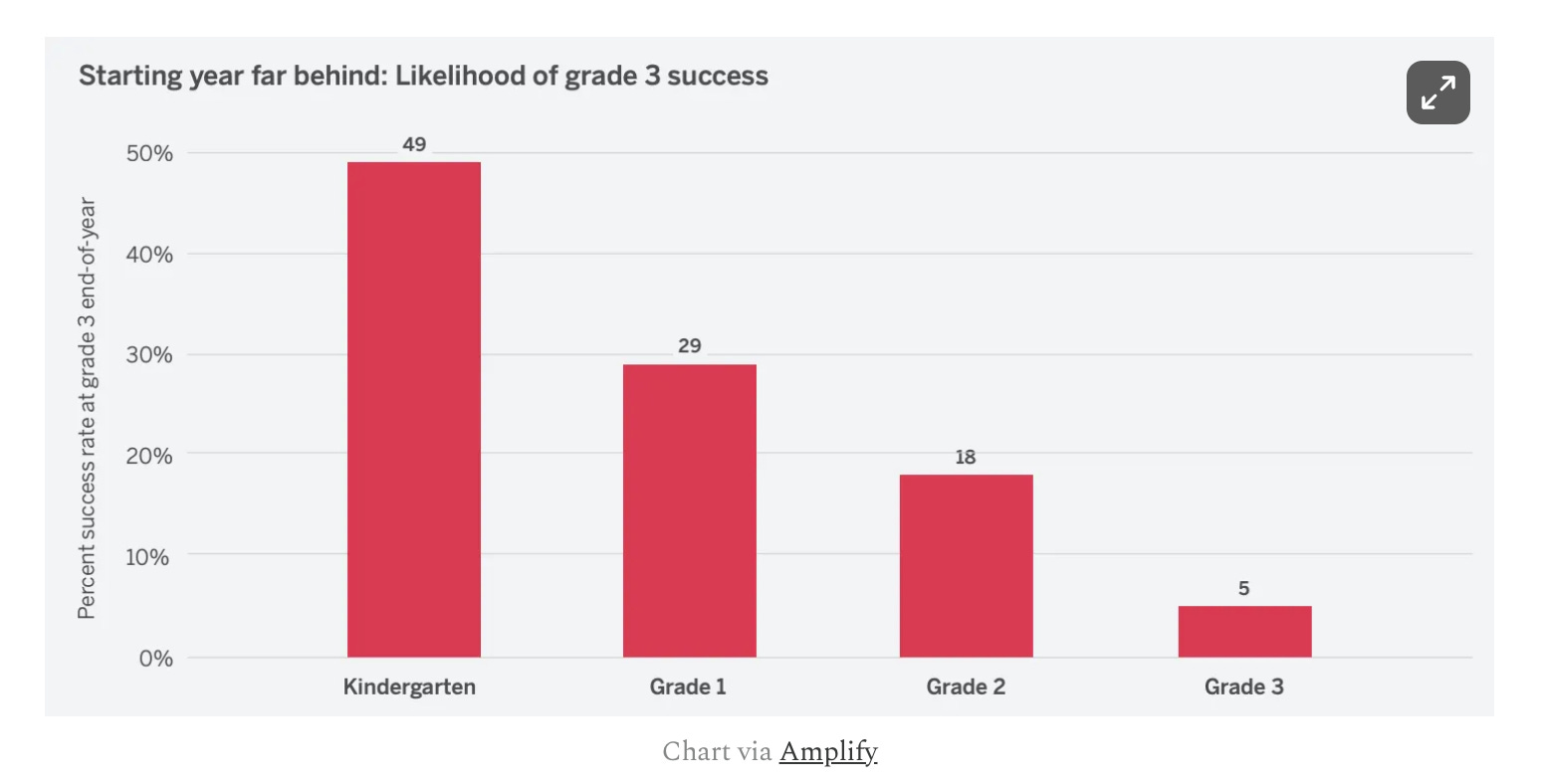
For instance, see this data from a Chad Aldeman post about not simply waiting for students to catch up. Rather than imminently developing at their own pace, students who do not grasp grade-level material the first time around tend to fall further behind.
Grade Levels Can’t Deliver
Whether you promote students who have fallen behind or hold them back, the “teacher in front of the classroom” model of education cannot truly accommodate dozens of learners working at various paces. It does not even appear to secure a minimum adequate education for a majority of students.
When age-based grade level enthusiasts argued that grade levels would enhance student motivation and teacher effectiveness, they were just plain wrong. And American children have been paying the price ever since.
There’s a saying (wish I could remember the originator) that our schools are doing a wonderful job of preparing the farm kids of 1890 for the factory jobs of 1910.
Just as the medium is the message, the process is the product. Schools teach obedience, loyalty, and productivity, not English, math, and science.
Grade levels and grades with a ~185 day school year make an employee molder and filter, not an education. Every child learns at a different pace, changing pace depending upon circumstances, but that’s not how we do it.
How we change from a productivity/obedience based system to a mastery based system is beyond me.
This really resonated. What stands out is that age-based grade levels didn’t just fail over time - they failed almost immediately, because children’s development was never uniform enough to support them. The way I see it, wide variation by age is a natural feature of human development, yet when learning is organised around narrow age expectations, difference becomes a problem of the child rather than the structure. Through my experience with child development as a therapist, and now being part of home education communities, I keep seeing this same mismatch.